
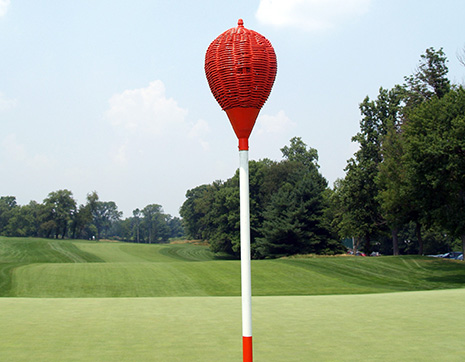
Merion Golf Club Gets Another Star Turn
During its distinguished 130-year history, Merion Golf Club has hosted many signature events that have been won by some of golf’s most legendary names.
Chick Evans won the 1916 U.S. Amateur Championship there. Bob Jones won the U.S. Amateur in 1924 and ’30. Ben Hogan captured the 1950 U.S. Open, and Lee Trevino topped the field at the ’71 U.S. Open. Merion’s reputation in the global golf community is impeccable, and the club has become a preferred destination for the game’s top players.
That’s why the United States Golf Association has chosen Merion to host the 2030, 2040 and 2050 U.S. Opens, as well as the 2034 and ’46 U.S. Women’s Opens.
“What happened is that the USGA learned that the great players of today want to win tournaments where the great players of yesterday won,” says Scott Nye, Merion’s Director of Championships. “It’s more meaningful for them to win at historic courses, like Oakmont, Pebble Beach, Pinehurst, The Country Club and Merion.
“The USGA said, ‘Let’s get these classic venues booked.’”
One of those bookings will occur from August 10-16, when Merion hosts the U.S. Amateur for a record seventh time. The grueling, week-long tournament brings together the best non-professional golfers from more than 30 countries, who must survive stroke play, match play and potentially two 36-hole daily marathons to earn the same title won by Evans, Jones, Arnold Palmer, Jack Nicklaus and Tiger Woods. This is the 126th playing of the tournament, which began in 1895 and which was not contested during World Wars I and II.
It’s a unique test of golf – PGA Tour events require four days and 72 holes of play – a chance to win the USGA’s oldest title and an opportunity for Ardmore-based Merion once again to show off the course that has made it one of golf’s most historic and challenging layouts.
“From the moment you step on the property, you can feel its long-standing history,” says USGA Senior Director of Championships Ben Kimball. “The fact that we have hosted more USGA championships there than at any other club in the U.S. and that it is one of the best golf courses in the world resonates. It’s fitting that we return there as often as we do.”
Merion will host matches throughout the week, but the tournament’s substantial size (312 golfers) creates a need for another course to handle the 36 holes of stroke play on August 11-12 that will winnow the field to 64 golfers. So, Philadelphia Country Club in Gladwyne, which was founded in 1890, and which nine years later became the seventh USGA member, will host golfers on the first two days of the Championship.
But the star of the week is Merion, which last welcomed the tournament in 2005, when Italy’s Edoardo Molinari became the first Italian and the first Continental European to win the U.S. Amateur. In 2025, 18-year-old Mason Howell became the third-youngest winner when he defeated Jackson “The Fridge” Herrington at San Francisco’s Olympic Club.
“Having been involved with the U.S. Amateur for so many years, maybe I’m biased, but I think it’s golf in its purest form,” Howell says. “You have amateur golfers fighting for the ultimate prize of being the national champion in our oldest championship.”
The U.S. Amateur is actually one day older than the U.S. Open, and it begins in June with local qualifying involving more than 5,000 golfers, at 48 sites around the country. Final qualifying takes place in July to produce a field of 312 that will head to Merion and Philadelphia CC for 18 holes of stroke play on August 10 and 11 that will cut the field to 64. On August 12, at Merion, those golfers will play 18-hole matches to cut 32 from the ranks. The next day, the rounds of 32 and 16 will take place. The quarterfinal matches take place on August 14, with the semifinals the next day. On Sunday, August 16, the two remaining competitors will play a 36-hole match to determine the winner.
“It is truly a grind, from beginning to end,” Kimball says. “And it truly changes the winner’s life.”
• • •
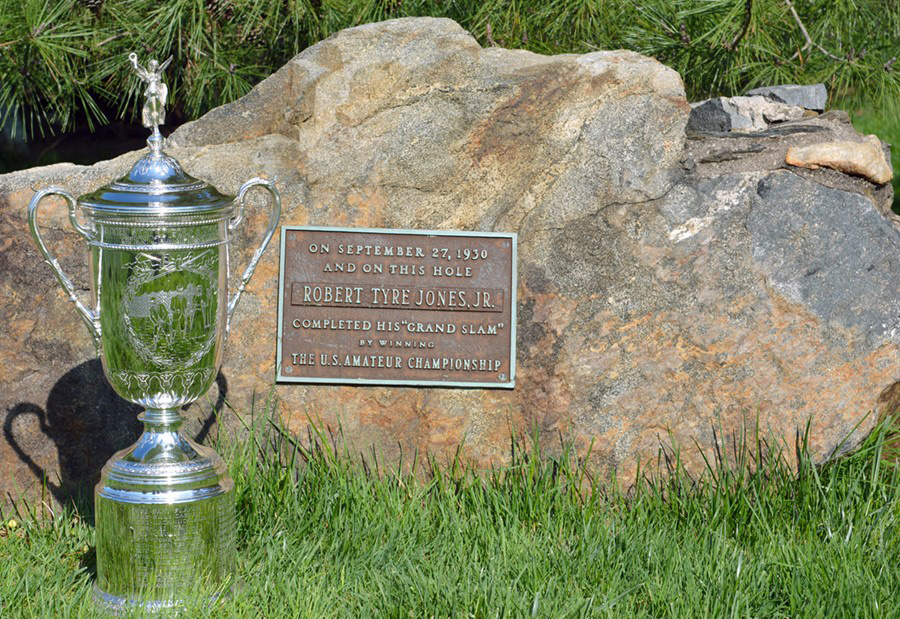
The U.S. Amateur was considered a “major” tournament from its inception until sometime in the 1950s. It joined the U.S. and British Opens and the British Amateur as the most important competitions. In 1930, Jones, who remains one of the seminal figures in golf history, became the only person to win all four majors in one calendar year.
In May, he defeated English golfer Roger Wethered at the British Amateur at St. Andrews in Scotland. A month later, at Royal Liverpool, he captured the British Open and, for the first time – during a conversation with writer Al Laney of the Herald Tribune in New York – spoke of his goal to win all four major tournaments. After surviving temperatures of up to 108 degrees to win the U.S. Open at Interlachen in Minneapolis, which caused the bantam-sized Jones to lose 10 pounds, he regrouped and prepared for the U.S. Amateur at what was then the Merion Cricket Club.
Six years earlier, Jones had won the tournament at Merion (he also won in ’25, ’27 and ’28), and he made clear his love of the course. On September 27, Jones drubbed Eugene Homans to win the U.S. Amateur. He had a seven-hole lead after the morning round and secured the triumph on the 11th hole in the afternoon. The golfing world celebrated the remarkable accomplishment, which Atlanta Journal writer O.B. Keeler dubbed “The Grand Slam.”
By the 1950s, as professional golf grew in popularity, thanks to players like Palmer, the U.S. Amateur lost some of its status among fans and media – but not within the USGA.
“In the eyes and hearts of the USGA, it’s still a major,” Kimball says.
• • •
In 2030, the golf world will celebrate the centennial of Jones’ unique accomplishment, and the U.S. Open will be staged at Merion as a fitting tribute to the legendary golfer. Fans can expect another jam-packed experience, like the one at the Open in 2013. However, things will be different for those attending the U.S. Amateur this August.
For one thing, there will not be the same crowds that fans experienced at the ’13 Open or in May during the PGA Championship at Aronimink Golf Club in Newtown Square. Despite the tremendous lineup of golfers scheduled to compete, the game’s biggest names – Rory McIlroy, Scottie Scheffler, etc. – will not be there. That removes some casual golf fans, who are attracted to the star power. There will also be much more modest hospitality and media presence at Merion for the U.S. Amateur.
And fans can get closer to the play at the U.S. Amateur than they can at even a regular PGA event, much less a major tournament. Because there are fewer spectators, there is less of a need to provide buffers between the galleries and the competitors. That makes for a more enjoyable viewing experience.
“For the U.S. Amateur Championship, we don’t have the same infrastructure we do for the U.S. Open Championship,” Nye says. “There are no grandstands. The spectators can walk behind the golfers. It’s more intimate.”
Because Merion is scheduled to host three men’s and two women’s U.S. Opens over the next 24 years, it’s unlikely it will stage the U.S. Amateur for quite a while. There is no arguing the impact on a club that holds a major, but being the site of the oldest American championship is also a significant distinction.
“Hosting the U.S. Amateur is generally considered one of the highest honors a club can get from the USGA,” Nye says. “It’s a pretty exclusive collection of clubs, and hosting elevates Merion’s stature worldwide.”
While the club will get a boost – although it is already considered one of the best courses on the planet – the winning golfer will also receive considerable esteem. Winning the U.S. Amateur is a tremendous achievement and can serve as a runway to tremendous professional success. Just look at the lineup of legends that have hoisted the Havemeyer Trophy.
“We say it within our building, ‘It’s as important as any of the championships we sponsor,’” Kimball says. “When you win a major, whether it’s the U.S. Open, the Senior Women’s Amateur or the U.S. Amateur Championship, to say you won it at Merion Golf Club and are in the same conversation with Bobby Jones or Edoardo Molinari is a big thing.
“It’s important to win the U.S. Amateur, but where you win it is especially important.”
This August, Merion Golf Club will continue its important role within the USGA.