
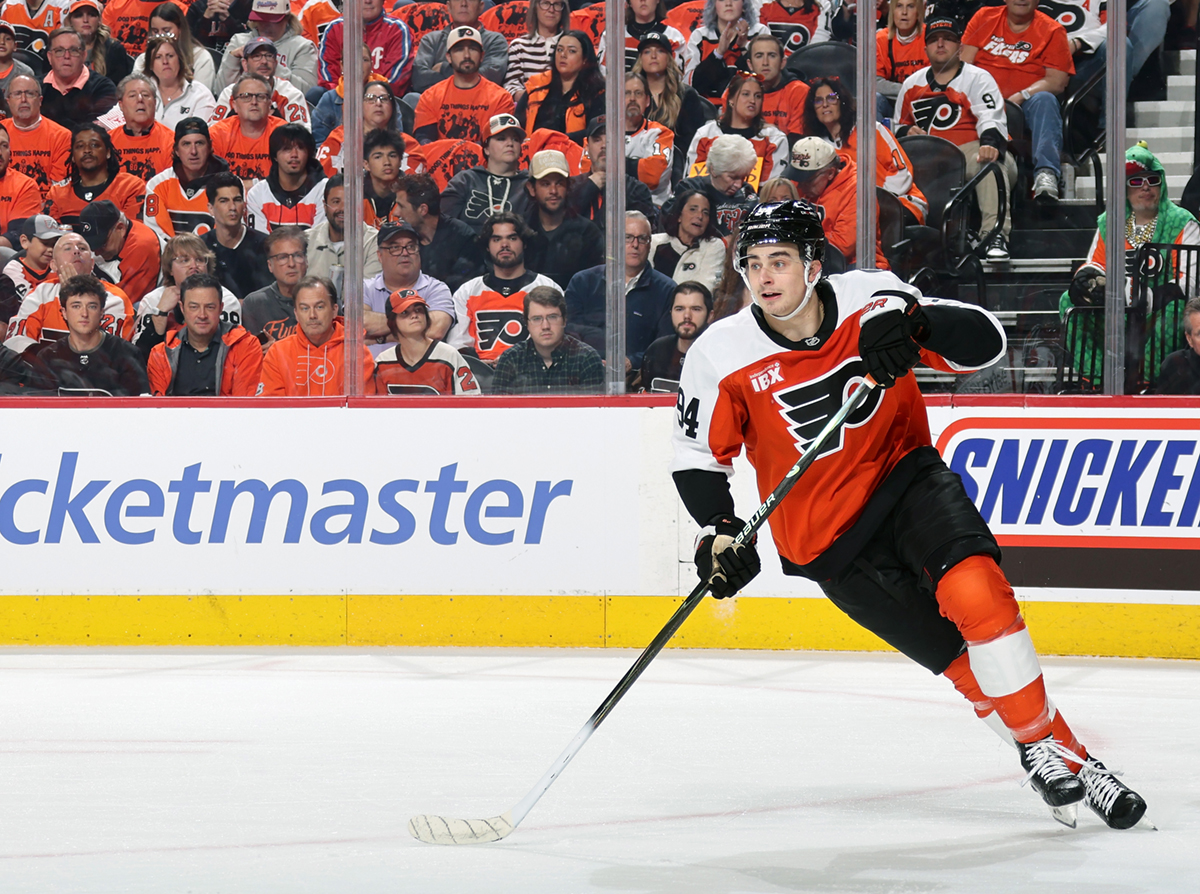
After Successful Season, Flyers Trying to Take Next Step
The Philadelphia Flyers overcame long odds and made great strides last season.
Despite MoneyPuck.com giving them just a 3.8 percent chance to make the playoffs with 16 games remaining, they secured their first postseason berth in six years. The Flyers then advanced to Round 2 by upsetting their bitter rivals from Pittsburgh, recording their first playoff-series win since 2012.
Can the progress continue?
Was this the first step toward being a legitimate Stanley Cup contender?
Did general manager Danny Briere do enough in the offseason?
Questions, questions, questions.
The answers figure to be based around the development of players like Matvei Michkov, ultra-promising Porter Martone, Trevor Zegras, Tyson Foerster, Cam York, Jamie Drysdale, Alex Bump, Oliver Bonk and Denver Barkey.
All are young, ranging from 19 (Martone) to 25 (York) at the start of the season. All have the ability to improve their games greatly and combine with the veterans – led by Travis Konecny, Travis Sanheim and Owen Tippett – to make the Flyers an upstart, exciting team.
It helps immensely that the long-troubled goalie situation is the best it has been in numerous years.
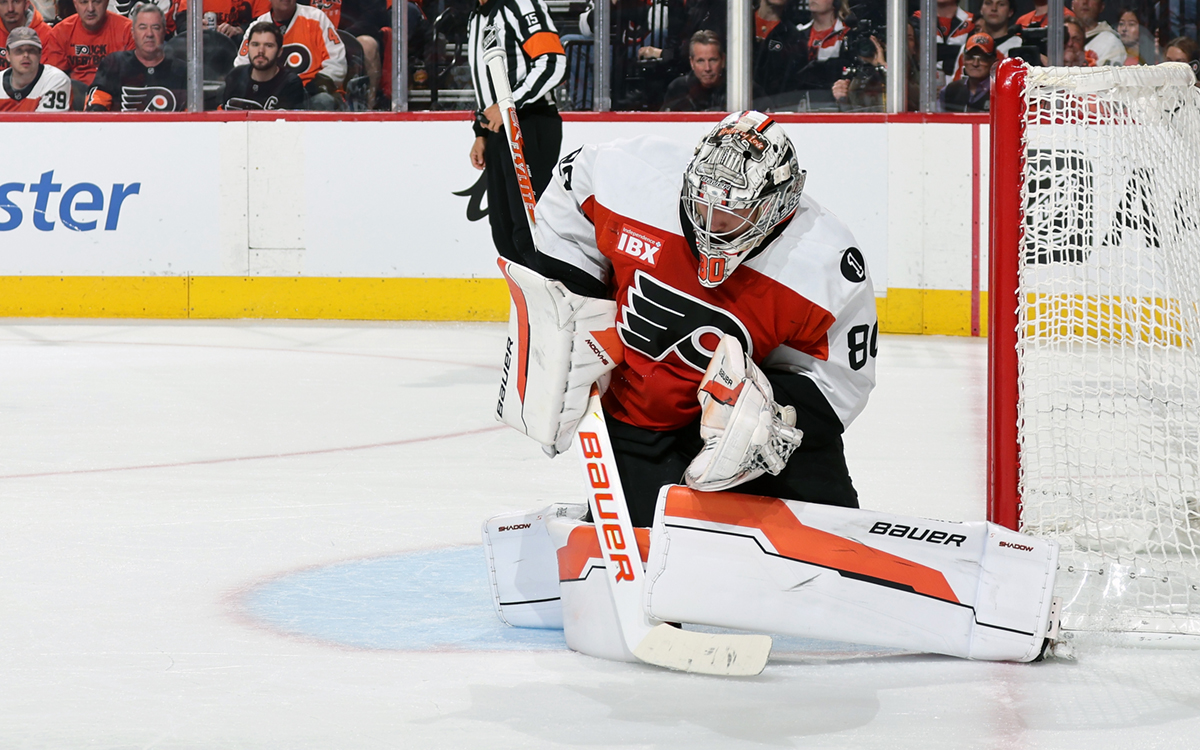
Dan Vladar, signed as a free agent in the summer of 2025, blossomed into one of the NHL’s most reliable goaltenders last season. And the Flyers solidified the position by acquiring Joseph Woll as his backup in the offseason.
With Vladar (2.42 goals-against average) displaying consistency throughout the season, the Flyers finished ninth in the NHL in goals-allowed (2.91 per game). That number will likely improve because Woll (2.94 career GAA), 28, is a major upgrade over the erratic Sam Ersson, who had a 3.12 GAA and .870 save percentage last season.
“We felt Woll was a step forward for us,” Briere said after completing the deal, which sent Ersson, promising defenseman Emil Andrae and a third-round draft pick to Toronto for Woll and defenseman Simon Benoit. “He’ll be able to help Vladdy in a tandem role.”
The belief is that Woll will keep Vladar fresh – and more effective — than Ersson (33 games, 29 starts). Vladar played in 52 games (51 starts) and in every minute of the playoffs last season.
“We hope they can push each other,” Briere said of the new goaltending duo.
While Briere seemingly improved the goaltending in the offseason, he was unable to land a much-needed No. 1 center. He made a staggering bid for restricted free-agent center Leo Carlsson, but he remained in Anaheim after the Ducks matched the offer: five years for a total of $90 million. Briere could have made a similar (though cheaper) offer for RFA (Restricted Free Agent) Columbus center Adam Fantilli – another player who would have filled the Flyers’ 1C hole – but declined.
That leaves a glaring weakness for the Flyers, who could have used a top-line center to also bolster their anemic power play.
So, for better or worse, the Flyers will look very similar to the team that finished 43-27-12 for 98 points in last year’s regular season before beating the Penguins in Round 1 and being swept by the eventual Stanley Cup champion Carolina Hurricanes in the second round.
Here is a look at the 2026-27 team:
Offense
Goals per game last year: 2.93 (21st in the 32-team NHL).
Projected lines
Line 1: Trevor Zegras (26 goals) centering Tyson Foerster (13 goals in 29 games) and Owen Tippett (team-high 28 goals).
A change of scenery helped Zegras (67 points) have a career year under new Flyers coach Rick Tocchet. Foerster got off to a great start last season, but was limited to 29 games because of arm surgery. He struggled in the playoffs (one goal and no assists in 10 games) but should be his high-scoring self. He and Tippett each have 30-goal potential.
Line 2: Christian Dvorak (18 goals) centering Travis Konecny (27 goals) and Porter Martone (4 goals, 10 points in 9 games).
This has the potential to be the Flyers’ highest-scoring line if Martone – who could become the franchise’s first Rookie of the Year winner – lives up to his gaudy buildup. Dvorak (51 points) will be an assist machine if centering these two talented wingers.
Line 3: Noah Cates (18 goals) centering Alex Bump (5 goals in 17 games) and Matvei Michkov (20 goals).
Cates (47 points) has developed into a solid two-way player, and he will try to ignite Bump, a promising rookie, and Michkov, who still managed 51 points in a somewhat disappointing sophomore season, one in which he came to camp in poor physical shape. He worked hard this summer and seems primed for a bounce-back season.
Line 4: Sean Couturier (12 goals) centering Denver Barkey (5 goals in 43 games) and Noel Acciari (13 goals).
Couturier gives the Flyers a strong presence on defense and the faceoff circle, and still has some scoring ability, especially when matched against a fourth line. Barkey is an up-and-coming player with grit, and Acciari, a free agent who signed a two-year deal for $5.6 million in the offseason, is defensively sound player who had 25 points last season with Pittsburgh.
Defense
Goals allowed per game last season: 2.91 (ninth in the 32-team NHL).
First pairing: Travis Sanheim (11 goals, 37 points, plus-12) and Rasmus Ristolainen (plus-10).
Sanheim, coming off a career season, anchors the defense with his all-around play. Ristolainen, who is in the final year of his contract, provides physicality but needs to stay healthy. He has played 70 games just once in the last seven seasons.
Second pairing: Cam York (26 points, plus-5) and Jamie Drysdale (8 goals, 32 points, minus-3).
York provided the signature moment of the 2025-26 season, scoring the series-clinching goal in overtime to beat Pittsburgh in Game 6, then heaving his stick joyfully into the crowd. Drysdale took some positive steps, but needs to keep climbing.
Third pairing: Nick Seeler (10 points, plus-1) and Oliver Bonk/David Jiricek, with Simon Benoit, Helge Grans and Hunter McDonald also in the mix.
Jiricek, a right-handed shooter acquired for Bobby Brink in March, has offensive potential and, if he sticks on the roster, could quarterback one of the power-play units. Seeler is a steady stay-at-home defenseman who blocks tons of shots – think Ed Van Impe if you’re a long-time Flyers fan. Bonk, a righty who was a first-round selection in 2023, has lots of composure and is a big part of the team’s future.
Goaltending
Believe it or not, this may be the best part of the team. And when is the last time you could say that about the Flyers and the game’s most important position?
Vladar, who signed a five-year, $27.5 million extension in July, is coming off a breakout season in which he had 29 wins and a .906 save percentage. The goaltender was even better in the playoffs, compiling a 2.18 GAA and .922 save percentage. During the regular season, he tied for the league’s best save percentage (.937) in five-on-five situations.
Woll should be a solid backup, but he needs to be healthier than he’s been throughout his career.
Special teams
They weren’t so special last season. In fact, the power play was abysmal. Again.
The Flyers finished last in power-play success (15.7 percent) for the fourth time in the last five seasons. Their penalty kill was mediocre, finishing tied for 21st by killing 77.6 percent of their infractions.
Coaching
Rick Tocchet begins his second coaching season in Philadelphia, trying to take the Flyers to Round 2 for the first time since 2012. He showed a knack for getting the most out of his players, with the exception of Michkov, who is the X-factor for 2026-27.
Prediction
Flyers huff and puff and sneak into the playoffs with 96 points — two fewer than last year — but are eliminated in the first round. That is, unless Briere makes an in-season deal and brings a quality center to Philly. If that happens, the Flyers could better last season’s surprising showing.